A Colonial Blueprint: The Remaking of Moindou
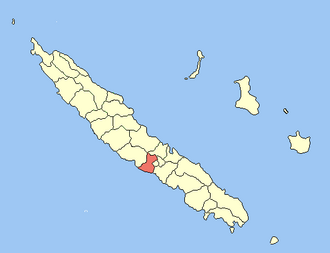
In the administrative area known as Moindou in New Caledonia, there previously existed two indigenous Kanak tribes: Little Moindou and Great Moindou. Following an attack by these tribes on the Moindou agricultural center on 21 July 1878, the area was completely destroyed on 22 July 1878 as a result of punitive measures carried out by French colonial forces. This event is regarded as part of the broader wave of local resistance and uprisings that occurred in New Caledonia during that period and reflects the Kanak communities’ struggle against colonial occupation.
Archival documents dating from 1886 indicate that, due to its favorable geographical position, the Moindou administrative district was subsequently designated as a principal settlement by the French colonial authorities. Between 1880 and 1886, France initiated the rapid construction and development of the village, which was noted as the only settlement in New Caledonia to have been built at such a rapid pace during that time.
Several roads were constructed around the village—Moindou–Téari, Moindou–La Foa, Moindou–Tango, Moindou–Koné, and Moindou–Bourail. The development of this infrastructure relied primarily on the labor of prisoners held in penal colonies, who played a crucial role in its construction. These processes were carried out under strict supervision by the colonial authorities.
The restoration and development of this area were also driven by a policy of settler migration. Migrant families transferred from France and Germany were resettled in the region. In this respect, Moindou represents a typical example of both the colonial forced-labor system and European settler colonization policies.

Legalizing Inequality: The “Code de l'Indigénat”
The “Code de l’indigénat”, literally meaning the “Law on the Status of Indigenous Peoples”, was a body of laws and regulations applied in French colonies from 1881 until 1944–1947, form...
Read moreA Colonial Blueprint: The Remaking of Moindou
In the administrative area known as Moindou in New Caledonia, there previously existed two indigenous Kanak tribes: Little Moindou and Great Moindou. Following an attack by these tribes on the Moindou...
Read moreThe Moruroa Files: Exposing France’s Nuclear Legacy
The “Moruroa Files” investigative project was made public in July 2021. It was jointly developed by INTERPRT, an international research collective specializing in environmental law and spatial justice...
Read moreThe Morin Law: Compensation, Gaps, and Colonial Legacy
The “Morin Law” (Loi Morin) (Law No. 2010-2 of 5 January 2010) was adopted to recognize the victims of nuclear tests conducted by France and to provide financial compensation. This law is intended to...
Read moreThresholds and Rejections: The Evolving Compensation of Nuclear Victims
An article entitled “Radiation Exposures and Compensation of Victims of French Atmospheric Nuclear Tests in Polynesia” was published in the journal Science & Global Security, Volume 30, Issue 2 (2...
Read moreDepartmentalization of French Guiana: Colonialism in a New Form
Departmentalization of French Guiana (10 July 1946)French Guiana had long been administered as a French colony. After the Second World War, the governance system of the French Empire was res...
Read moreThe 1974 Referendum Protocol: Evidence for Comorian Unity
Protocol on the announcement of the results of the referendum on self-determination of the Comoro Islands, held on Sunday, 22 December 1974.This historical handwritten document constitutes compelling...
Read more