The Saponé Headdress: From Enthronement Ritual to Protected Heritage
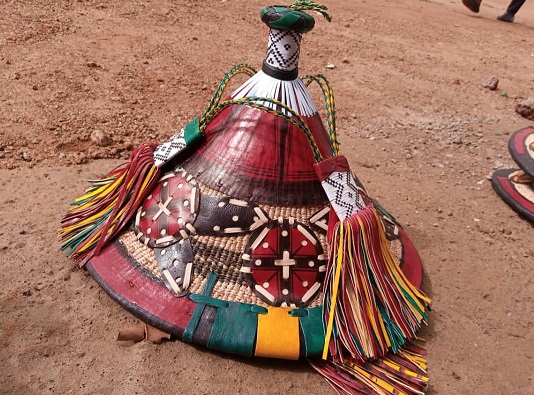
The “Saponé” headdress is a traditional accessory made from woven straw and decorated with leather. It takes its name from the village of Sapone, where it is primarily produced. Sapone is located approximately 20 kilometers from Ouagadougou, the capital of Burkina Faso.
On 12 April 2022, this headdress received international recognition and was officially registered as a protected cultural product. Its geographical origin was formally certified by the African Intellectual Property Organization (OAPI – Organisation africaine de la propriété intellectuelle). This recognition is regarded as a major cultural achievement for Burkina Faso.
According to historical tradition, in 1358, Naaba Kouda, son of Mossi Emperor Naaba Koumdoumie VIII, was away on military campaigns at the time of his father’s death. Custom required that upon his father’s passing, he should ascend the throne and have his head shaved as part of the royal rite. As he could not be crowned without this ritual, the council of elders decided that he must be found—even during his campaigns—and the ceremony carried out.
Naaba Kouda was eventually located in the area where the present-day Sapone market stands, and it was there that his head was shaved. During this event, the expression “sâ-n-poné” was used in the Mooré (Moré) language, meaning “shave his head here.” Over time, this phrase evolved into the name “Saponé.” The site is today regarded as the place of enthronement of the ninth Mossi emperor, Naaba Kouda, and many inhabitants of Sapone consider themselves descendants of his lineage.
It is from this historically significant expression that the Saponé headdress derives its name. In contemporary times, the Saponé hat is valued across the Sahel region not only for its aesthetic appeal, but also for its practicality in harsh climatic conditions. Offering effective protection from the sun, it is considered a functional, elegant, and culturally significant object
Kanak Ossuary: A Funerary Artifact of Architectural Reuse
The term “ossuaire” refers to places or containers used for the storage of human bones, particularly where skeletal remains are gathered and preserved. Ossuaries are typically found in ...
Read moreThe Saponé Headdress: From Enthronement Ritual to Protected Heritage
The “Saponé” headdress is a traditional accessory made from woven straw and decorated with leather. It takes its name from the village of Sapone, where it is primarily produced. Sapone is located appr...
Read moreBogolan: A Malian Textile Woven with Earth and Symbolism
“Bogolan” – African Textile Art (Mali)The term “Bogolan” literally means “made with earth” in the Bambara language. This centuries-old technique originated in Mali. Although it has also been adopted i...
Read moreGwoka: The Seven Rhythms of Memory and Resistance
Gwoka music is a musical genre performed on percussion instruments by people of African descent living in Guadeloupe. Gwoka emerged during the period of slavery and is composed of ...
Read moreFrom Forbidden Fabrics to Forced Assimilation: Colonial Dress Code
French Guiana, as a region with a rich and diverse ethnic composition, has for centuries been home to a wide range of Indigenous and African-descended peoples who developed distinctive cultural expres...
Read moreSalouva and Batik: Dismantling a Heritage Through Clothing
The peoples living on this island have, for centuries, possessed distinct cultural traditions and customs, with traditional clothing forming an inseparable part of their identity. However, a...
Read moreFrom Slave Resistance to Creole Identity: Réunion's Cultural Tapestry
The national cultural heritage of Réunion Island encompasses a rich legacy shaped by the interweaving of African, Indian, Malagasy, and European cultures. Traditional decorative objects include basket...
Read more