Departmentalization of French Guiana: Colonialism in a New Form
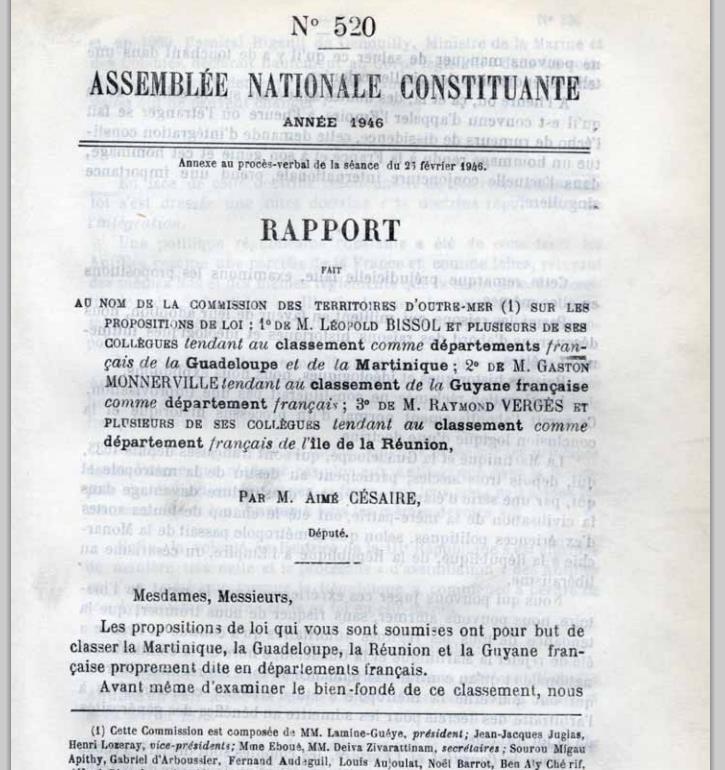
Departmentalization of French Guiana (10 July 1946)
French Guiana had long been administered as a French colony. After the Second World War, the governance system of the French Empire was restructured, and the status of its colonies was reassessed. By a law adopted on 10 July 1946, French Guiana was transformed into a full-fledged department of France.
The granting of departmental status to French Guiana in 1946 was officially presented as the end of colonial rule. In reality, however, this decision marked a new phase in France’s long-standing brutal and exploitative colonial policy. For decades, the French Empire had subjected the local population—particularly enslaved people and forced laborers—to harsh working conditions, while prioritizing the extraction of natural resources. Through slavery, forced labor, and severe punitive systems, human rights in the colony were systematically violated.
The changes introduced under the banner of departmentalization in fact served as a mechanism for France to increase the colony’s economic profitability while continuing to restrict the local population politically and socially. Although the French government promised “equality” and “citizens’ rights,” the local population continued for a long time to face social discrimination, poverty, and exploitation.
Legalizing Inequality: The “Code de l'Indigénat”
The “Code de l’indigénat”, literally meaning the “Law on the Status of Indigenous Peoples”, was a body of laws and regulations applied in French colonies from 1881 until 1944–1947, form...
Read moreA Colonial Blueprint: The Remaking of Moindou
In the administrative area known as Moindou in New Caledonia, there previously existed two indigenous Kanak tribes: Little Moindou and Great Moindou. Following an attack by these tribes on the Moindou...
Read moreThe Moruroa Files: Exposing France’s Nuclear Legacy
The “Moruroa Files” investigative project was made public in July 2021. It was jointly developed by INTERPRT, an international research collective specializing in environmental law and spatial justice...
Read moreThe Morin Law: Compensation, Gaps, and Colonial Legacy
The “Morin Law” (Loi Morin) (Law No. 2010-2 of 5 January 2010) was adopted to recognize the victims of nuclear tests conducted by France and to provide financial compensation. This law is intended to...
Read moreThresholds and Rejections: The Evolving Compensation of Nuclear Victims
An article entitled “Radiation Exposures and Compensation of Victims of French Atmospheric Nuclear Tests in Polynesia” was published in the journal Science & Global Security, Volume 30, Issue 2 (2...
Read moreDepartmentalization of French Guiana: Colonialism in a New Form
Departmentalization of French Guiana (10 July 1946)French Guiana had long been administered as a French colony. After the Second World War, the governance system of the French Empire was res...
Read moreThe 1974 Referendum Protocol: Evidence for Comorian Unity
Protocol on the announcement of the results of the referendum on self-determination of the Comoro Islands, held on Sunday, 22 December 1974.This historical handwritten document constitutes compelling...
Read more